
Delta County Parole Versus Probation
Texas parole follows a prison sentence. The Texas Board of Pardons and Paroles decides whether an eligible person will be released on parole and sets the release conditions. The TDCJ Parole Division then supervises the person. Mandatory supervision is another TDCJ release mechanism governed by statute and board review in qualifying cases. Neither is the same as a court releasing a Delta County defendant on probation.
Probation, also called community supervision, comes from the sentencing court. A person may receive it without ever entering TDCJ custody. The court and its Community Supervision and Corrections Department hold the key records. The Delta County/District Clerk says local records are not online. Research did not establish a statewide public probationer name lookup for Delta County, so a blank TDCJ result says nothing certain about probation.
| Question | Parole or mandatory supervision | Probation |
|---|---|---|
| Who authorizes it? | Texas Board of Pardons and Paroles under the state-prison framework | The county or district court in the criminal cause |
| Who supervises it? | TDCJ Parole Division; Delta County is assigned to Paris DPO | The court's Community Supervision and Corrections Department |
| Best first record | TDCJ Parole Review Information, vote result, and office assignment | Judgment or order imposing community supervision |
| Proof it ended | TDCJ discharge or supervision-status record | Discharge, completion, early-termination, or revocation order |
TDCJ uses discharge for completion of the sentence and release from incarceration, parole, mandatory supervision, or another identified supervision. It means more than leaving a prison unit.
How to Verify Delta County Supervision
Begin by deciding whether the person entered TDCJ or remained in a local court case. Use a TDCJ or SID number when available because name-only matches can be uncertain. Preserve the exact labels returned and the date checked. TDCJ says its information updates on working days and is at least 24 hours old.
- Identify the case path. Ask whether the person served a state-prison sentence, left Delta County Jail, or received community supervision from a Delta court.
- Check the state record. Use the TDCJ Inmate Information Search and open Parole Review Information for a known state case.
- Confirm review status. Before a decision, call BPP at 844-512-0461 with the name, TDCJ or CID number, and date of birth.
- Route an approval correctly. After a favorable vote, call the TDCJ Parole Division at 512-406-5202 for release processing. Approval alone is not proof the person left custody.
- Verify local reporting. For a released TDCJ case assigned to Delta County, contact Paris District Parole Office about the office assignment.
- Use the court for probation. Ask the Delta County/District Clerk for the judgment and later discharge, revocation, early-termination, or completion order in the correct cause.
The Delta County released-inmate search and records guide covers the separate task of proving release from the county jail. A sheriff's booking-out record does not establish parole, and a supervision record does not supply the jail-door time.
Delta County Parole at Paris DPO
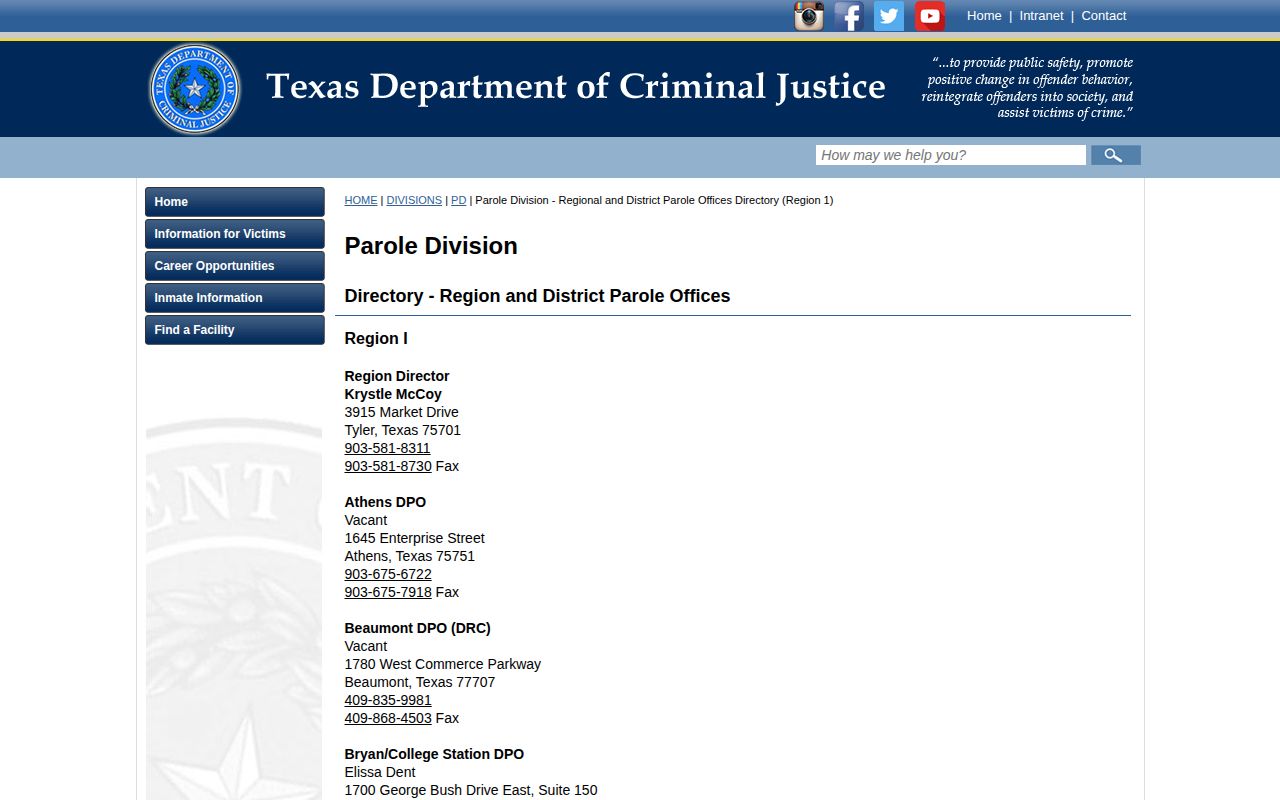
TDCJ's county cross-reference assigns Delta County to the Paris District Parole Office in Region I. This is the local office for a known TDCJ parole or mandatory-supervision case. It is not the Delta County Jail records desk, and it does not administer ordinary court probation.
Paris District Parole Office
TDCJ Parole Division, Region I
3905 North Main Street
Paris, TX 75460
Phone: 903-785-4492
Fax: 903-784-2056
Use the office for reporting assignment or supervision questions after confirming that the person is in the TDCJ parole system.
The official Region I directory is the source for this office and its contact details.
Delta County Parole Review, Not Hearing
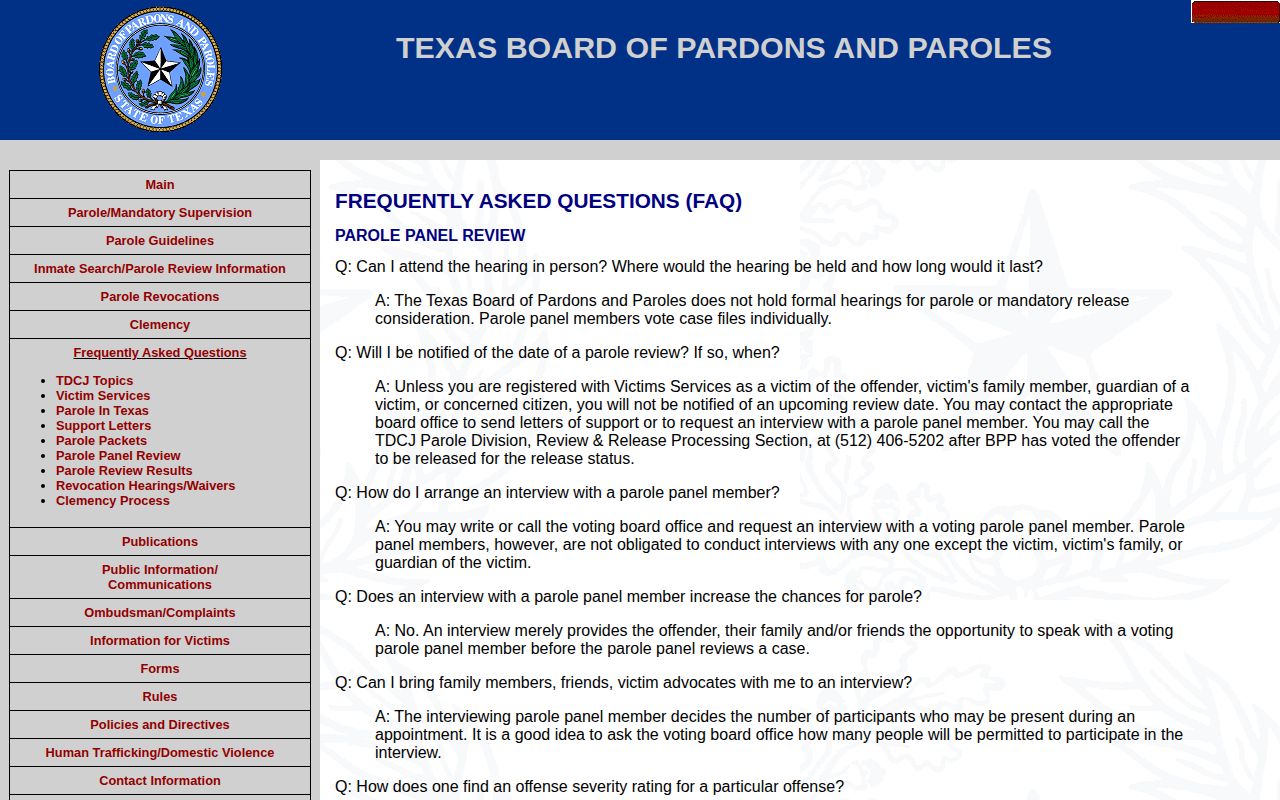
Texas does not publish an ordinary person-by-person parole hearing calendar because BPP does not conduct a formal oral hearing for routine parole or mandatory-supervision consideration. Public Board meeting minutes concern agency governance and should not be treated as an inmate hearing schedule.
TDCJ identifies a case about six months before initial eligibility and about four months before a later review. An Institutional Parole Officer interviews the person and prepares a summary. The file then moves to the assigned board office, where a three-member panel votes in sequence. Two matching votes decide the result. Those timing windows describe agency workflow, not a promise of a public event on a fixed day.
The BPP panel-review explanation documents the no-formal-hearing rule.
Reading Delta County Parole Results
Vote codes describe board action, not physical departure. FI-1 generally authorizes release when eligible. FI-2 sets a future month and year. FI-3R through FI-18R link release to a program, facility, or timing condition. RMS means release to mandatory supervision. NR denies release and sets another review month and year, while SA means serve all with no ordinary later parole review, subject to mandatory-supervision consideration where the law permits it.
| Result | Careful reading |
|---|---|
| FI-1 | Favorable when eligible, but processing and other holds may remain. |
| FI-2 | Favorable action tied to a future month and year, not release today. |
| FI-R family | Release depends on the named program, facility availability, or timing. |
| NR | Denied with a later review setting, not an order to release on that review date. |
| SA | Serve all for ordinary parole review, with mandatory supervision treated separately where applicable. |
New information can cause an approval to be withdrawn. Once a favorable result appears, the Parole Division release-processing number is the useful next channel. The actual custodian remains the source for the date and time custody ended.
Delta County Violations and Absconder Checks
Release conditions come from the controlling order and can vary by case. A suspected violation may lead to investigation, a warrant, or revocation proceedings, but a rumor or missing online entry is not a status finding. Contact the supervising or issuing authority for the named case.
TDCJ's public absconder portal is specifically a Sex Offender Absconder Information Search. It is not a complete list of all people on parole, all alleged absconders, or all active warrants. Likewise, the Texas DPS sex-offender registry applies only when Chapter 62 requires registration. A person absent from either narrow tool has not thereby been cleared of a warrant or shown to have completed supervision.
Note: A no-result in a limited registry cannot replace direct confirmation from the court, TDCJ, Paris DPO, or the issuing agency.
County notification also changed on September 1, 2025. Texas IVSS-Counties replaced county VINE, while TDCJ IVSS remains a separate state-prison and parole service. Delta participation in the county portal must be checked live. These systems can deliver status-change notices, but an alert should still be paired with the official custody or supervision record.
Where Delta County Release Questions Go
Delta County's 2026 sheriff relocation affects records, custody, and property inquiries after release. Administrative and public services moved to 30 Texas Highway 24 on May 1, 2026, while the announcement kept jail operations and dispatch at the existing facility. The new public-services address is not a documented release door, property counter, or waiting area.
Call the Delta County Sheriff's Office at 903-395-2146 before visiting and say whether the question concerns a record request, present custody, dispatch, property, or release pickup. For a TDCJ supervision issue, use Paris DPO. For probation, identify the sentencing court and its Community Supervision and Corrections Department. That routing avoids sending a court-supervision question to a parole office or a jail-property question to the wrong sheriff site.
How Delta County Supervision Ends
For TDCJ parole or mandatory supervision, obtain the agency's discharge or status record for the named incarceration. A web search no longer returning the person is not enough because the reviewed sources do not promise that every fully discharged person remains in public results. TDCJ inmate information is available by email at pia@tdcj.texas.gov, by telephone at 936-295-6371 or 800-535-0283 during published weekday hours, and through a focused Public Information Act request for historical records.
For Delta County probation, ask the clerk for the signed order that states what happened. Route the request by the court shown on the cause, including the 8th Judicial District Court or 62nd Judicial District Court where applicable. A completion or discharge order, early-termination order, or revocation order must be described in its own terms. Completion does not automatically expunge the case, and a deferred-adjudication discharge does not have the same legal effect as an acquittal or dismissal.
Texas Government Code Chapter 552 governs executive-agency records, while judicial records follow the court-access framework. Narrow the request by full name, cause or TDCJ number, court, and date range. Ask for existing public portions rather than asking an office to create a narrative. This produces a record that distinguishes active supervision, completed discharge, revocation, and release from custody.